Chargeback fees in 2026: what Stripe, Paddle, Lemon Squeezy and Adyen actually charge
Every provider publishes a headline rate and buries the dispute fee. Here is the dispute fee for each, with the detail that matters: whether you get it back when you win. Then the part the fee tables never show, which is that the fee is the cheapest thing about a chargeback.
The fee table
Figures from each provider's published pricing or help centre as of November 2026. Where the provider does not print a number, we say so rather than guess.
| Provider | Fee per dispute | Refunded if you win? | Where it comes from |
|---|---|---|---|
| Stripe | $15 "dispute received" + $15 "dispute countered" if you respond + $15 "dispute appealed" if you appeal | Received: no. Countered: yes. Appealed: no. | Your Stripe balance. Connect platforms cannot pass the fee to connected accounts. |
| Paddle | $20 / £20 / €20 (40 CAD or AUD) | No, even when won | Deducted from your seller balance with the disputed amount |
| Lemon Squeezy | $15 (widely reported; not on the pricing page) | Not stated | Deducted from your next payout |
| Adyen | Set by contract; sources quote €7.50 to €15 plus scheme fees | Depends on contract | Your Adyen account |
| paas.build (UniPaaS) | Follows the UniPaaS fee schedule, disclosed before you go live | Per schedule | Your UniPaaS balance; 3DS2 and fraud screening included in the 3.9% rate |
Three details are worth a second look. Stripe's countered fee is the only one in the table that comes back when you win, and Stripe also offers a "Smart Disputes" option that keeps 30% of the recovered amount on wins instead. Paddle's help centre states that the fee stays even when Paddle wins the dispute on your behalf, because the underlying provider fee is non-refundable; an older Paddle support page quotes $15, so your contract decides. And on Stripe Connect, the platform eats the fee: Stripe does not let you pass dispute fees to connected accounts.
What a chargeback really costs
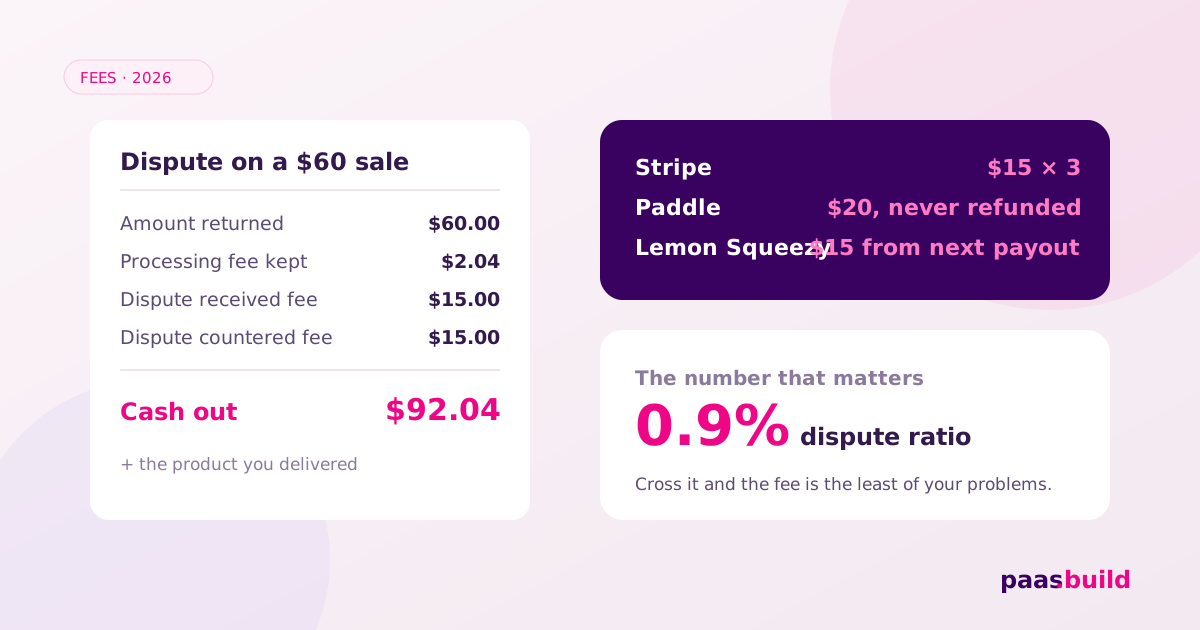
Take a $60 subscription payment that gets disputed on Stripe and lost after you respond.
| Line | Amount |
|---|---|
| Disputed amount returned to the cardholder | $60.00 |
| Original processing fee (2.9% + 30¢), not returned | $2.04 |
| Dispute received fee | $15.00 |
| Dispute countered fee (lost, so not refunded) | $15.00 |
| Product or service already delivered | your cost |
| Cash out | $92.04 plus the goods |
A lost $60 dispute costs more than $90. Win it and you are still out $15 and the hours spent assembling evidence. Which is why the numbers people argue about online, $15 versus $20, are the wrong numbers.
The number that actually matters: your ratio
Visa and Mastercard both run monitoring programmes that count disputes against your transaction count every month. The widely used thresholds are around 0.9% of transactions and 100 disputes for Visa's dispute monitoring programme and 1.5% and 100 disputes for Mastercard's excessive chargeback programme, with lower "early warning" tiers below them. Cross them and the fines are monthly and escalate; stay there and the acquirer closes the account. For a merchant of record like Paddle or Lemon Squeezy, that ratio belongs to them, which is why MoRs are quick to suspend sellers who generate disputes. For a direct Stripe or Adyen account, it is yours.
So the practical rule: a $15 fee on a $60 sale is a nuisance; a 1% dispute rate is an existential problem, whatever the fee.
What prevents chargebacks (ranked by what we see)
We run acquiring for thousands of small businesses on UniPaaS. The disputes that reach us cluster into a few avoidable causes.
- Unrecognised descriptor. "PAAS*BUILD 4471" on a bank statement generates "I didn't buy this" disputes from people who did. Put the name the customer knows you by in the descriptor, with a phone number or URL.
- No 3DS on the first payment. 3D Secure 2 shifts fraud liability to the issuer on authenticated transactions. Most providers charge extra or make you configure it; on paas.build it runs on every first payment by default.
- Refund harder than dispute. If your refund takes an email and three days and a dispute takes one tap in a banking app, customers dispute. A visible, fast refund path is the cheapest chargeback prevention there is.
- Subscription surprise. Trials that convert silently and annual renewals with no reminder are the biggest source of subscription disputes. Send the renewal email; it costs nothing and the card schemes increasingly require it.
- Pre-dispute alerts. Visa's RDR and Verifi, and Mastercard's Ethoca, let you refund a transaction in the hours before it becomes a formal dispute. It still costs you the sale, but not the fee or the ratio.
How the merchant-of-record model changes the answer
With an MoR, the dispute is legally theirs: they respond, they carry the ratio, they pay the scheme fee. They then recover the amount and their fee from your balance, so you still pay. What you gain is that disputes do not threaten your processing relationship, because you do not have one. What you lose is control over how the dispute is fought and, with most MoRs, the fee even when it is won. We went through the broader trade-off in MoR vs PayFac: who owns your customer?.
What we charge
Dispute and refund fees on paas.build follow the standard UniPaaS schedule and are shown to you before you go live, not discovered on a statement. 3DS2 and fraud screening are included in the 3.9% rate rather than sold as add-ons, because the cheapest chargeback is the one that never happens.
3DS2 on by default. Descriptor you control.
Go live in one prompt, with the dispute protections most providers charge extra for.
See pricing →