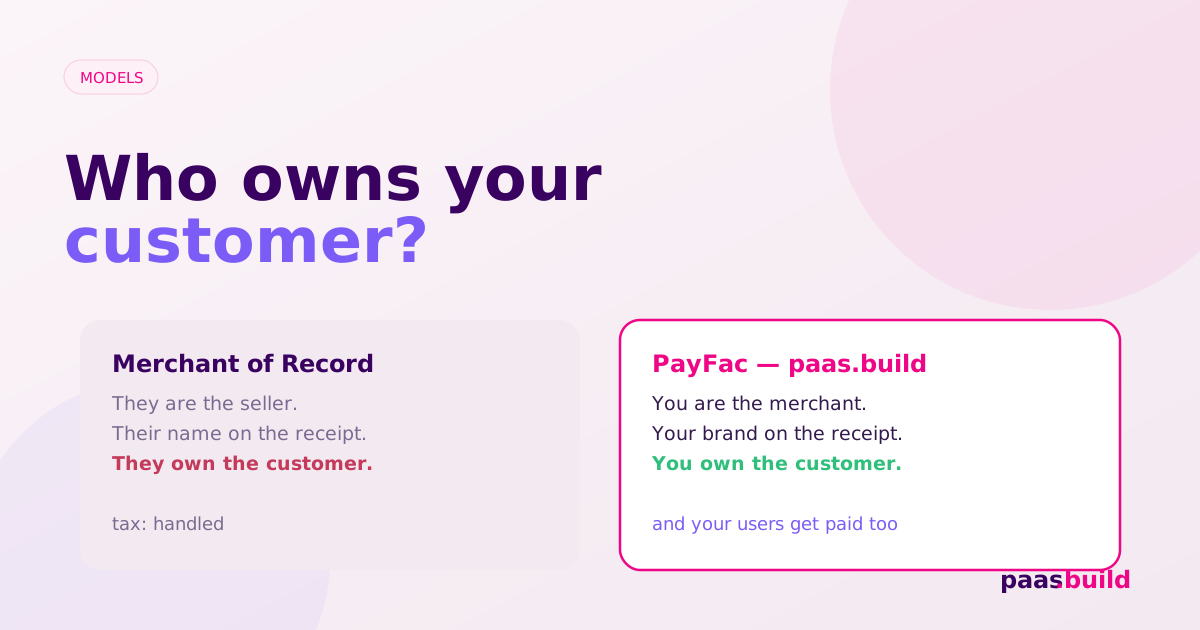
MoR vs PayFac: who owns your customer?
Every "add payments" decision is really a decision about ownership. Merchant of Record and Payment Facilitator solve the same surface problem — take money — but they hand you very different businesses underneath. One trades your customer relationship for tax simplicity. The other keeps it. Here's how to tell which you actually want.
Three ways money can move
Strip away the branding and there are three models a builder chooses between:
- Payment processor (PSP) — e.g. Stripe raw. It moves money from the customer's bank to yours and stops there. Tax, liability, compliance: yours. Maximum control, maximum assembly.
- Merchant of Record (MoR) — e.g. Paddle. It becomes the legal seller. It owns the order, remits the tax, eats the chargeback risk — and its name, not yours, is on the receipt.
- Payment Facilitator (PayFac) — e.g. paas.build. You are the merchant, but the heavy regulated machinery is run for you. Your brand on the checkout; the compliance handled behind it.
The real difference is liability — and the customer
A PSP takes on none of the responsibility beyond moving the money. An MoR takes on all of it. That's the genuine appeal of merchant-of-record, and it's a real one: sell into a hundred countries, and someone else registers and remits sales tax in every jurisdiction, absorbs the fraud, answers the billing disputes.
But that convenience has a price that isn't on the pricing page. Because the MoR is the legal seller, it — not you — owns the transaction. Its descriptor is on the card statement. The terms are its terms. Increasingly, the customer relationship is intermediated by it. You've outsourced the tax headache and, quietly, handed over the customer.
An MoR solves your tax problem by becoming your seller. Read that twice — it's the whole trade.
The line an MoR cannot cross
Here's the part that decides it for a lot of AI builders, and it's structural, not a feature gap. A merchant of record sells your product. It is legally the seller of the thing you make. That means it fundamentally cannot move money between your users.
If your app is a platform — a marketplace, a community with creators, a booking tool, a vertical SaaS where members get paid — you don't just need to charge customers. You need to onboard your users, split each payment, and pay everyone out. An MoR has no mechanism for that, because it can only ever be the one seller in the middle. For platform payments, the MoR question answers itself: it's out.
| Merchant of Record | PayFac (paas.build) | |
|---|---|---|
| Who's the seller | Them | You |
| On the receipt | Their name | Your brand |
| Owns the customer | Them | You |
| Global tax remitted for you | Yes — the real win | You're the merchant (tax tooling + guides) |
| Your users get paid | Impossible | Core capability |
| Payments can earn you money | No — always a cost | Yes — rev-share on platform volume |
So which should you pick?
Be honest about your shape, and the answer is usually clear:
Choose a Merchant of Record if…
Your revenue is globally scattered from day one, you have no legal entity, and you never want to think about VAT. That's what MoR is for, and it does it well. Pay the premium and enjoy it.
Choose a PayFac if…
Your core market is the UK, EU or US. You want your name on the checkout. Your app moves money between users. You'd rather payments earn than just cost. Then you want to stay the merchant — and a PayFac lets you, without making you assemble it yourself.
The tax convenience of merchant-of-record is genuine, and we won't pretend otherwise — for the globally-scattered seller it can be worth the trade. But for a builder shipping into the UK, EU or US, and especially for anyone building a platform, "who owns my customer?" is the question that matters more than "who files my tax?" Answer that one first.
Stay the merchant.
Your brand, your customer, your users paid too — with the regulated part run for you. 3.9%, one rate.
See platform payments →