The revenue leak nobody sees
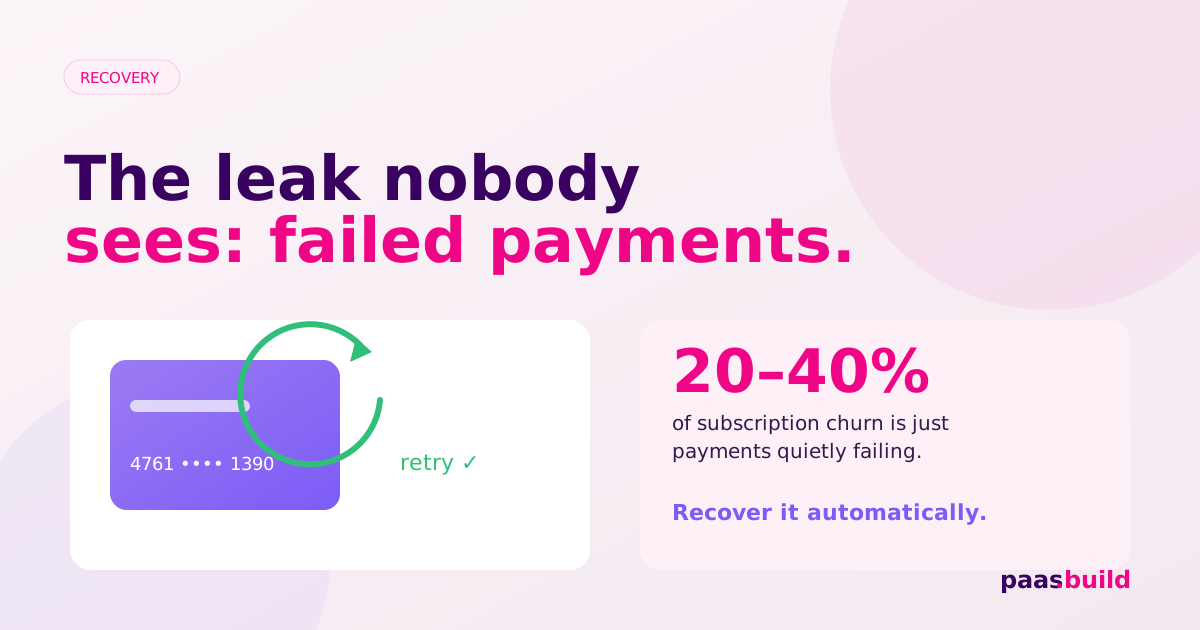
You obsess over the churn you can see — the cancellation, the angry email, the exit survey. Meanwhile a bigger leak runs silently in the background: customers who never meant to leave, whose payment just quietly failed. It's the most recoverable revenue you have, and most builders never look at it.
Involuntary churn is a different animal
There are two kinds of churn, and they need opposite responses. Voluntary churn is a decision — someone chose to leave, and your job is to change their mind. Involuntary churn is an accident — the customer is happy, still wants the product, and doesn't even know they've lapsed. Their card expired, hit a limit, got reissued after a fraud flag, or the bank declined a routine renewal.
The mistake is lumping them together in one "churn" number. When you do, involuntary churn hides — and it's often the larger, cheaper-to-fix half.
The happiest customer you'll lose this month is one whose card expired and nobody retried it.
Why payments fail (and it's rarely "no money")
Builders assume a decline means an empty account. Usually it doesn't. The common causes:
- Expiry — the single biggest bucket. Cards roll over constantly; the subscription doesn't know.
- Reissued cards — after fraud or loss, the number changes but the customer is fine.
- Bank-side friction — routine declines from risk systems, especially cross-border, that succeed on a retry.
- Soft limits — a temporary hold that clears in a day.
Almost all of these are recoverable — if something retries intelligently instead of giving up on the first no.
The mechanics of recovery
"Dunning" is the unglamorous name for chasing failed payments. To dun is, literally, to make persistent demands — and done well, a combination of tactics recovers the large majority of involuntary churn. Three levers do most of the work:
- Smart retries. Not "try again tomorrow," but retrying at the moment most likely to succeed — factoring the failure code, card type, day of week, and region. Timing is the whole game.
- Local acquiring. Routing a renewal through a local rail in the customer's country lifts acceptance by a few points on its own. A payment in local currency is measurably more likely to clear.
- Card updaters. When a card is reissued, the network can quietly hand you the new details — recovering a meaningful slice of the cards due to expire, with zero customer action.
Two rails beat one
Cards fail; bank debits don't expire. Offering Direct Debit alongside cards for renewals removes an entire category of failure — there's no expiry date to lapse. On paas.build, recurring runs on card and Direct Debit, so fewer months quietly break.
Make recovered revenue a metric
What gets measured gets fixed. The strongest subscription apps track recovered revenue as a first-class growth number, right next to ARR and LTV. It reframes recovery from a support chore into what it actually is: one of the highest-ROI growth levers you have, because the customer already said yes. You're not acquiring anyone. You're just not dropping them.
Start by separating involuntary from voluntary in your reporting. You can't recover a leak you've averaged away.
Stop the silent leak.
Card + Direct Debit renewals, smart retries, local rails — recovery built into the rails, not bolted on.
Subscriptions →