Reduce churn: 5 moves, quantified
Growth gets the attention, but retention is where the compounding lives. A point of churn saved this month keeps saving every month after. Here are five tactics that actually move the number — ranked by how much ARR churn each one removes, so you can start with the biggest lever.
First, a mental model. Sort every retention tactic on two axes: is the churn voluntary (a decision) or involuntary (a payment accident), and are you acting before the customer leaves or after? That gives you four quadrants — and a rule of thumb: start with lagging, measurable levers, because you'll see the impact fastest.
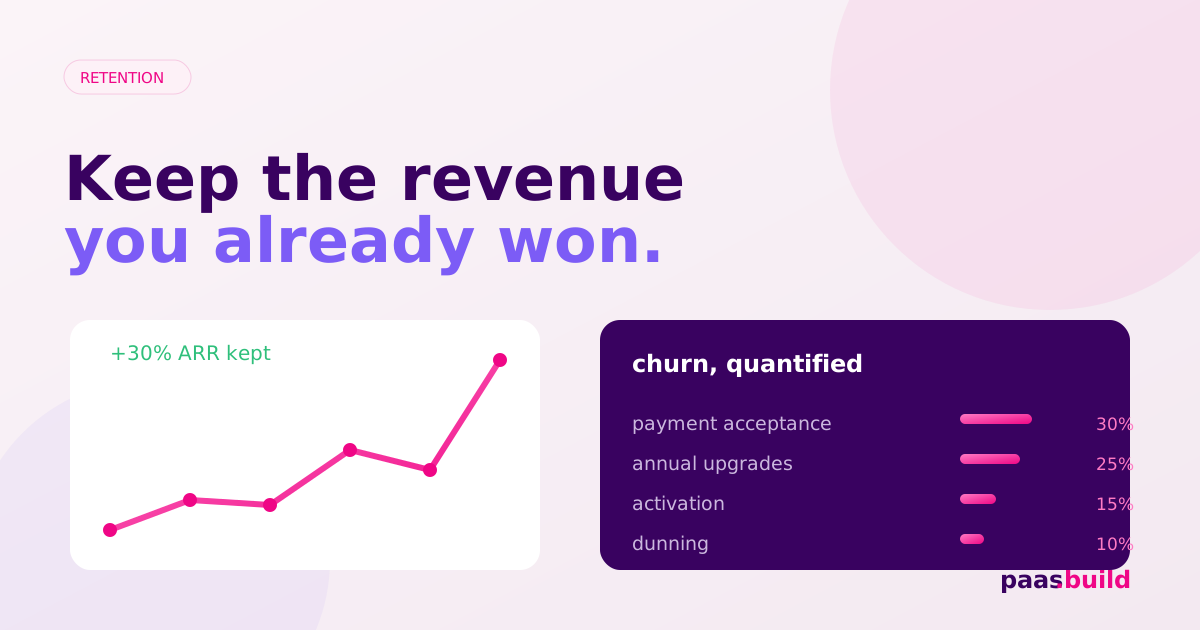
| Move | ARR churn cut | Type |
|---|---|---|
| Improve payment acceptance | ~30% | Involuntary · pre-churn |
| Upgrade users to annual | ~25% | Voluntary · pre-churn |
| User-activation campaigns | ~15% | Voluntary · pre-churn |
| Dunning campaigns | ~10% | Involuntary · post-churn |
| Cancellation flows & offers | ~5% | Voluntary · post-churn |
1. Improve payment acceptance — the biggest, quietest lever
The largest number on the list isn't a growth tactic at all — it's making sure the payments you should be collecting actually clear. Local acquiring lifts renewal acceptance by a few points; charging in local currency makes a payment measurably more likely to succeed; card updaters quietly recover a slice of expiring cards. None of it touches your product, and it removes churn the customer never intended. Start here.
2. Move customers to annual
An annual plan is twelve months of churn resistance bought in one decision. There's a clean negative correlation between the share of revenue on annual plans and monthly churn — more annual, less churn, reliably. One well-known case moved from 2% to 21% of customers on annual and watched voluntary churn fall with it. A simple "save two months by paying yearly" prompt, shown at the right moment, does real work.
Every customer you move to annual is a customer who can't churn for a year.
3. Activate before you retain
The customer who never got value is already half gone. Activation campaigns — in-app walkthroughs, nudges toward the "aha" action, reactivation of dormant users — attack churn at its root, before anyone reaches for the cancel button. It's slower to instrument than a retry rule, but it compounds, because an activated user is a retained user by default.
4. Dun the failures you can recover
When a payment fails, a good dunning program — smart retries plus clear customer messaging across email and in-app — recovers a large share of that involuntary churn. It's post-churn, so it's cleanup rather than prevention, but the customer already wanted to stay, which makes it some of the cheapest revenue you'll ever save. (We went deep on this in the revenue leak nobody sees.)
5. Give the leaver a reason to stay
The last line of defense is the cancellation flow. Done right — an offer to pause, a downgrade, a targeted discount, or just a better-timed annual upsell — it saves a meaningful chunk of at-risk customers who were one friction away from staying. It's the smallest lever on the list, but it's also the easiest to ship, so it's a fair place to prove the loop works before you invest upstream.
Why order matters
You don't need all five on day one. Ship them biggest-first, one every couple of weeks, and measure each in dollars retained. Payment acceptance and annual upgrades will likely dwarf the rest — which is lucky, because they're also the ones that don't require rebuilding your product.
The compounding you're buying
Here's why this beats chasing signups. Cutting monthly churn from 3% to 2% isn't a one-percentage-point improvement — over twelve months it's roughly 9% less ARR churned, because retention compounds the same way interest does. New revenue you have to win again every month. Retained revenue keeps paying you. Fix the leak once and it stays fixed.
Retention starts at the rails.
Better acceptance, annual plans, Direct Debit, recovery — built into paas.build, not bolted on after.
See subscriptions →